
The four stages of a professional install
- 1
Strip and excavate
Existing lawn, roots and topsoil out to roughly 75mm, or about 100mm where vehicles will run. Sprinkler lines capped. Spoil carted off site.
- 2
Build the base
Road base or crushed rock in, wetted and plate-compacted, then a screeded layer of crusher dust, then a second screed pass to the finished levels.
- 3
Compact and set the falls
At least two compaction passes, worked as hard as the plant will take it, with falls set toward a defined exit point rather than left flat.
- 4
Lay, join, secure and dress
Consistent pile direction, joins taped with fibres kept clear of adhesive, pegs at 30-40cm on soil or adhesive and foam underlay on concrete, then 10-15kg per square metre of sand power-broomed in.
Why the base carries the whole job here
Artificial turf is a flexible surface. It takes the shape of whatever is underneath it, permanently. Every ripple, dip and soft spot in the base becomes a visible feature of the lawn, and unlike natural grass it will not grow out of it. That is true anywhere. What makes it acute in the Illawarra is that the ground is unusually good at producing ripples, dips and soft spots.
Two mechanisms do most of the damage. The first is reactivity: clay that changes volume with moisture. The soil landscape report for the Berkeley unit under Figtree records "Highly reactive soils" in its Surface Movement Potential section, and the Illawarra Escarpment unit under half of Thirroul and nearly half of Bulli notes that "ie3 is moderately reactive. Potential movements may be set off by poor drainage". Read that last sentence twice, because it links the two problems: movement is triggered by water that has nowhere to go.
The second is bearing strength when wet. Gwynneville, Shellharbour and Kiama units all carry a "low wet bearing strength" limitation on their subsoils. Soft subsoil under a compacted base means the base sinks into it in patches, and a lawn that was flat in March is not flat in September.
The engineering answer to both is the same: get the water out. A base is not just a level platform, it is a drainage layer with a designed exit. Ask where yours goes.
What changes suburb by suburb
- Escarpment streets, Thirroul and Bulli. Thirroul is 51.5 per cent Illawarra Escarpment, Bulli 45.6 per cent, and the report's landscape limitations for that unit include "Steep slopes" and "Extreme erosion hazard". Slope means retention, set-out and access as much as it means drainage.
- Footslope suburbs, Corrimal, Balgownie and Fairy Meadow. Majority Gwynneville, with shallow soils on the lower slopes and a low-permeability gw3 subsoil. Textbook clay-and-drainage base design.
- Fill sites, Unanderra and parts of Shellharbour. Unanderra is 47.3 per cent Disturbed Terrain and Shellharbour 14.8 per cent. The unit report asks for "a survey at a suitable scale as well as geotechnical analysis" on this ground. Practically, that means an installer should be cautious about quoting a fixed excavation price sight unseen.
- Alluvial flats, Horsley. Over 99 per cent Fairy Meadow unit across two map sheets, with "high seasonal watertables" and "Seasonal waterlogging" listed. The base has to sit above the problem, not fight it.
- Kiama and the south. Kiama splits 45.5 per cent Kiama unit, whose "subsoil ka4 is moderately reactive" with "low permeability", and 42.5 per cent Bombo, "shallow (<50 cm)" on the crests with rock outcrop. Deep clay and shallow rock inside one suburb.
Mapping is at 1:100,000 and describes suburb polygons, not individual backyards. It tells you what questions to ask, not what your yard is. Full detail sits in the escarpment clay and drainage guide, and the money side is in the Illawarra artificial grass price guide.
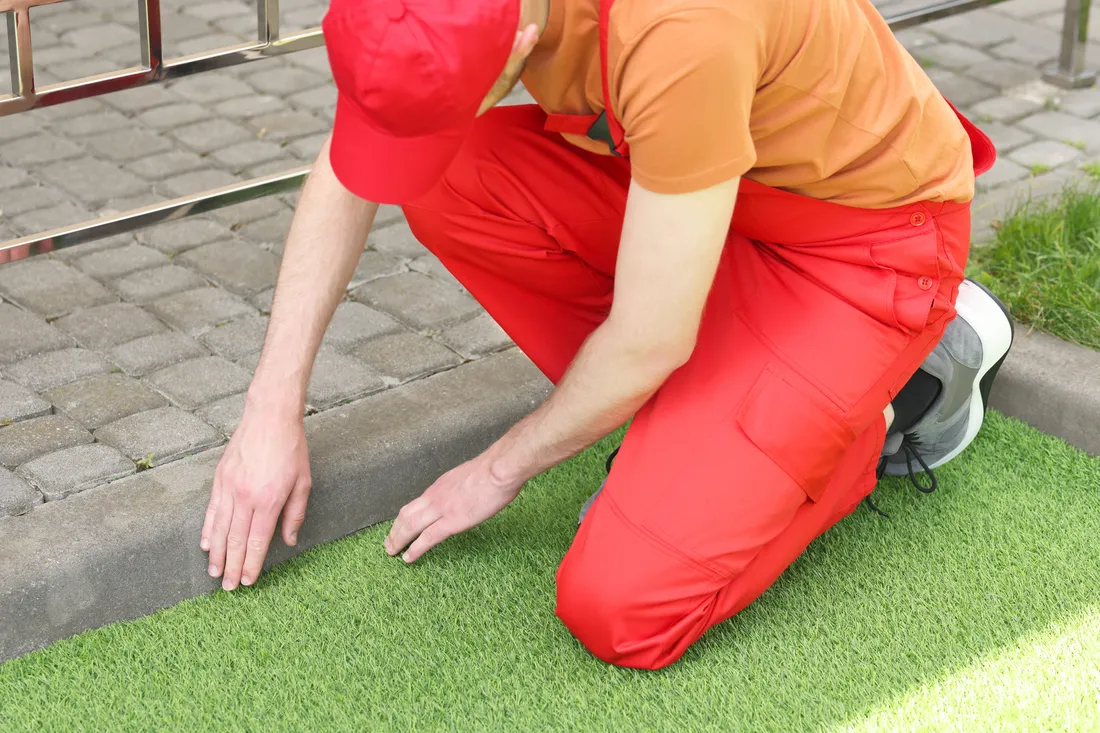
The specification to insist on in writing
Everything on this list becomes invisible the moment the turf is unrolled, which is exactly why it belongs on the quote:
- Excavation depth in millimetres, and what happens if the crew hits fill or rock.
- Base material and thickness, and the number of compaction passes.
- Whether a weed membrane is included. Practice genuinely varies between installers and it is a fair question, not a gotcha.
- The drainage detail: falls, any aggregate drain or outlet, and the point water actually leaves at.
- Edge restraint type and fixing spacing, and peg spacing on soil (commonly 30-40cm).
- Infill product and rate in kilograms per square metre.
- The turf by pile height, backing type (polyurethane holds up better than latex in warm humid conditions) and warranty term, not by a brand name alone.
- Spoil removal and tipping fees: included, or extra.
Note what most warranties do and do not cover. Manufacturer terms commonly sit in an 8-15 year band and typically cover UV fade and fibre loss, not base failure. The part most likely to fail early on Illawarra ground is the part the warranty will not touch. There is a shorter overview of turf quotes across the Illawarra if you want the summary first.
Also worth reading
Installation questions, including the council ones
How deep should the excavation be on Illawarra clay?
There is no Australian Standard that sets excavation depth for artificial turf as a function of soil type. Anyone who tells you there is has invented it. The common trade practice is roughly 75mm for a lawn and about 100mm where a vehicle drives over it, and on reactive clay or fill an installer may go deeper and build more base rather than less. What matters is that the number is written into your quote in millimetres, so it can be checked against what actually happens on the day.
Does AS 2870 apply to my turf job?
No. AS 2870 is a residential footings and slabs standard called up by the National Construction Code for the foundations under houses, garages and sheds. It is not a landscaping standard and it imposes nothing on a turf installer. Its site classification language is useful only as a way of describing soil reactivity, and the NSW soil landscape reports describe Illawarra soils directly and for free, which is the better source.
Can I put artificial turf on my nature strip?
Ask your council first, and note that the three Illawarra councils are in different positions. Wollongong City Council does not publish any position on synthetic turf on the verge. Its Verge Garden Guidelines do say 'Do not install any structures or hard surfaces in your verge garden' and that 'The use of any hard landscaping materials or irrigation systems is also not permitted', but the guidelines never mention artificial or synthetic turf at all. Shellharbour City Council publishes no verge or nature strip policy. Kiama Municipal Council names no turf rule either, but states plainly that 'You need to get approval from Council before you do any work on public roads, footpaths, or land between a road and private property', granted under Section 138 of the Roads Act 1993. On that wording, verge work in Kiama needs approval first regardless of material. None of this affects the lawn inside your fence.
Will Wollongong Council reinstate my verge if the water main is dug up?
No, and Council says so in writing. Its Verge Garden Guidelines state that utilities or Council may excavate part or all of a verge garden and that 'there is no obligation from the utility service providers or Council to reinstate a verge garden after the work is undertaken'. Whatever you spend on the strip outside your fence, you are spending on public land at your own risk.
How long does an installation take?
No Australian installer publishes a reliable per-job timeframe, so we will not manufacture one. What we can say is where the time goes: most of it is excavation, spoil removal, base construction and compaction, not laying grass. On a fill site or a block where the only access is a side gate, those stages stretch. Ask for a timeframe in writing with your quote.
What is the most common way a job goes wrong here?
Base preparation, and specifically compaction and drainage. Both CHOICE and installer guides identify base prep as where DIY and cut-price installs fail. On ground the soil reports describe with phrases like 'Locally impeded drainage' and 'low wet bearing strength', an under-compacted or poorly drained base shows up as dips, ripples and a soggy surface within a couple of wet seasons, and the fix is to lift the turf and start again.
Do I need to water anything during or after the install?
The base is wetted before compaction, which is a job task rather than something you manage. After that the lawn needs no watering to survive. Sydney Water's Water Wise Guidelines still apply to everything else in the yard: before 10am or after 4pm for hoses, sprinklers and watering systems, with smart and drip systems permitted between 10am and 4pm, and hosing hard surfaces not permitted unless it is for safety, health, emergency, construction or contamination reasons.
Have someone look at the actual ground
Send the suburb and rough size. One vetted Illawarra installer will measure up and quote the base as well as the grass.
Get a free, no-obligation quote
Tell us a little about your job and we'll pass it to a vetted local installer.