
Dog runs and side returns
Narrow high-traffic strips down the side of the house, where natural grass never survives and mud tracks straight through the back door.
A pet-grade turf system has three layers and each one has to pass liquid. The pile lets it through, a permeable backing takes it down, and the base carries it away. Australian product baselines put minimum drainage capability around 30 litres per square metre per hour, and some suppliers advertise dramatically higher figures on their own pet products, which are worth checking against that supplier's data sheet rather than taking from a headline.
None of that helps if the third layer is a bathtub. The Gwynneville unit that covers most of Corrimal, Fairy Meadow and Balgownie is described in its report with a gw3 soil rated "Low permeability" and a limitations line naming "impermeable, low wet bearing strength clay subsoils". The Berkeley unit under a fifth of Figtree lists "Locally impeded drainage" outright. On that ground, urine and rain both need somewhere to go, and the somewhere has to be built.
What a good installer does about it: falls set toward a defined exit, an aggregate drainage layer that is genuinely open rather than choked with fines, and on the worst sites a subsurface drain to daylight or a stormwater connection. Ask to have that detail written into the quote in the same way you would ask about excavation depth. There is more on base construction in the Illawarra installation walkthrough.
Narrow high-traffic strips down the side of the house, where natural grass never survives and mud tracks straight through the back door.
Full pet-grade lawns with a drainage exit designed in, for yards that turn to sludge every winter on footslope clay.
Small enclosed spaces for apartment and townhouse dogs. If the space is strata, the by-laws come first: see the balcony and courtyard guide.
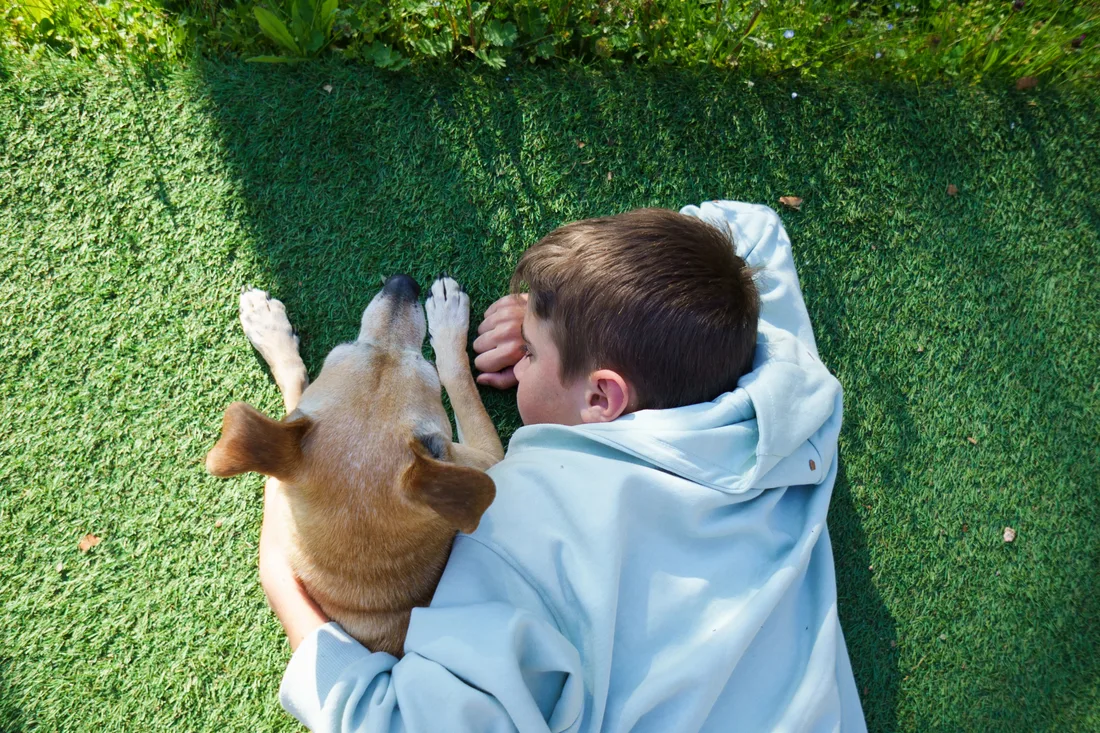
Three things are true at once and a page that only tells you the first is selling. Artificial turf removes mud, holes and the winter dead patch a dog creates on clay, and it does not need watering. It also runs hotter than grass in full sun, needs an active cleaning routine to stay pleasant, and CHOICE notes it carries a larger lifecycle carbon footprint than natural grass along with up to 60 per cent higher runoff. That runoff point is worth thinking about specifically here, on a coastal strip that already receives 1148.5 mm a year and drains to the ocean.
None of that is a reason not to do it. It is a reason to size the job, design the drainage and understand the maintenance before you sign, rather than after. The same principle runs through everything on our Wollongong artificial grass home page.
Independent consumer body CHOICE says yes, on two conditions: that drainage is installed properly, and that you are willing to keep up a cleaning routine. Both conditions are doing real work in that sentence, and in the Illawarra the first one is the harder of the two.
Through the backing, into the base, and then wherever the base sends it. That is the whole issue. Liquid passes through a permeable pet backing quickly, but underneath it the soil landscape reports for this area use phrases like 'Low permeability' and 'Locally impeded drainage'. If the base has no designed exit, liquid and the ammonia with it sit at the bottom of it. A pet yard on Illawarra clay needs its drainage designed, not assumed.
Zeolite is the standard Australian pet infill. It absorbs ammonia from urine before the odour builds. Published dosing rates by dog size come from UK and US sources rather than Australian ones, so treat any kilograms-per-square-metre figure you are quoted as a supplier's planning number rather than a national standard, and ask which product it is. Standard silica or kiln-dried sand at roughly 10-15 kilograms per square metre is what goes into a normal lawn.
Solids picked up daily, the same as on grass. Urine zones hosed after use. An enzyme cleaner over the high-traffic areas about weekly, because enzymes break down uric acid rather than just masking it. A roughly half-and-half vinegar and water mix is the common DIY deodoriser: leave it 15 to 20 minutes, brush, rinse. Monthly brushing against the pile direction keeps the fibres upright wherever the dog runs the same line every day.
A determined digger can lift an edge, which is why edge restraint and fixing spacing matter more on a pet job than on a plain lawn. Pegs at 30-40cm intervals are the common practice on a soil base, and adhesive is used where turf meets concrete. Once the perimeter is properly restrained there is nothing loose for a dog to get a claw under in the middle of the lawn.
Hot enough to matter on a clear summer afternoon. Western Sydney University researcher Dr Sebastian Pfautsch has recorded unshaded artificial turf approaching 100 degrees Celsius. Bellambi's January mean maximum of 25.0 degrees is mild for Australia, but surface temperature and air temperature are different measurements and turf runs far above ambient in direct sun. Shade is the strongest fix, lighter-coloured yarn helps, a hose down drops the surface quickly, and some suppliers sell cooling infills. Where a supplier claims a specific percentage cooler, that is their claim and worth asking them to substantiate.
Yes, modestly. Published Australian pricing puts pet-grade installs at roughly $100-145 per square metre against about $85-140 for a standard residential lawn. The premium buys a higher-permeability backing, the odour-control infill and usually a shorter, denser pile. The base work, which is the part that decides whether the yard smells in February, is priced the same way as any other job.
For a pet yard in a warm, humid coastal climate, polyurethane. Trade guidance is that PU absorbs less moisture and holds up better to heat and dimensional change, while latex is cheaper but ages more rapidly in hot humid conditions. Between the escarpment and the sea, with 1148.5 mm of mean annual rainfall recorded at Bellambi AWS over 27 years, humid is the operating condition rather than the exception.
Tell us the suburb and the rough area. A vetted local installer will look at the drainage as well as the grass, free of charge.
Tell us a little about your job and we'll pass it to a vetted local installer.