
Where these jobs come from around here
Three sources, mostly. Older Illawarra houses through Corrimal, Unanderra and Figtree came with generous concrete: side paths, a back patio, a clothesline apron, a carport slab that has not held a car in twenty years. Newer townhouse and unit developments came with paved courtyards and no soil at all. And a good number of walled courtyards were poured to solve a mud problem on clay and then created a heat and hardness problem instead.
In each case somebody wants soft green ground without paying to break up and cart away perfectly good concrete. Which is reasonable, because demolition and disposal are among the more expensive things you can do to a small yard.
The rest of what we publish about turf across Wollongong, Shellharbour and Kiama deals with the opposite case, where the base still has to be built from nothing.
The method, and how it differs from a lawn
A soil install is mostly earthworks: excavate, build base, compact, screed, lay, peg, dress. A slab install deletes the first four steps, because the base already exists and is already compacted.
- Clean and dry the surface. Adhesive needs a sound substrate free of dust, moss and loose material.
- Assess the fall. Establish where water currently runs and where it exits, before anything is covered. This is the step that gets skipped.
- Underlay. Around 5mm of foam, which cushions the surface and evens out minor imperfections. It must pass water rather than trap it.
- Bond, do not peg. Turf adhesive replaces pegs, applied so the surface can still drain rather than as a continuous sealed film.
- Join and trim. Consistent pile direction, joining tape under seams, fibres kept out of the adhesive, sharp blades changed often.
- Dress. Sand infill still goes in, weighting the turf and keeping the pile upright.
The stage sequence for a full soil job, for comparison, is on the installation page, and the stage costs are broken down in the guide to laying artificial grass and what each stage buys.
The fall problem, in detail
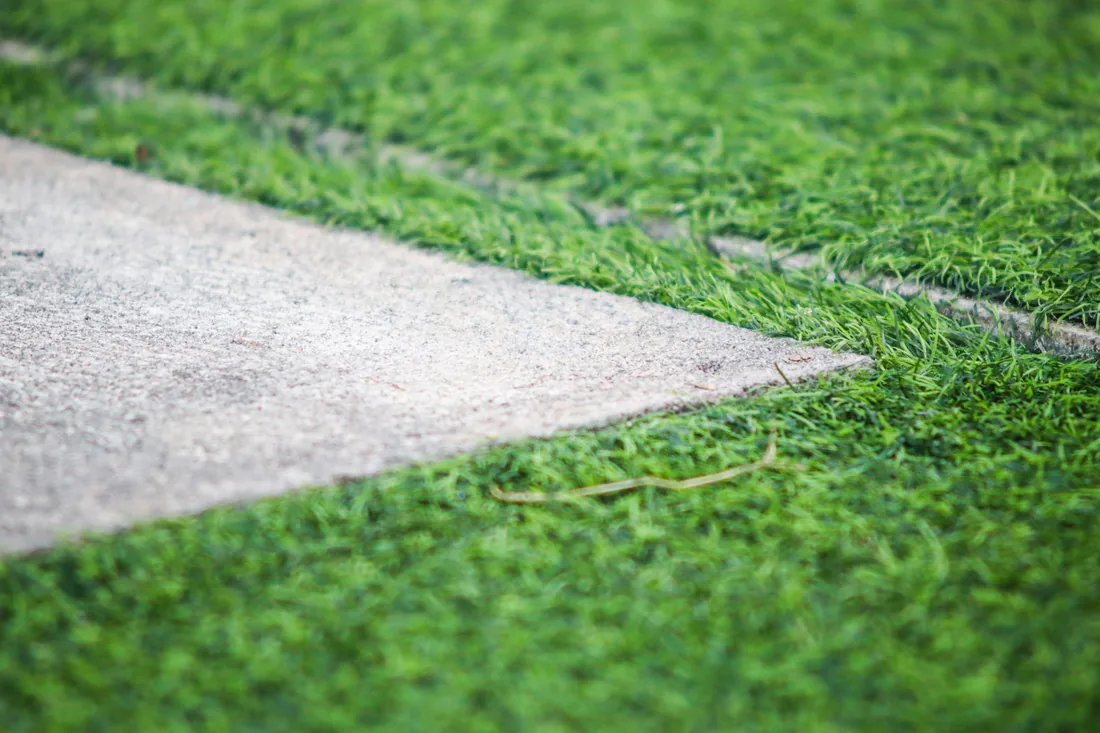
Concrete is impermeable. That is the whole point of it, and it is why this job is easy and why it fails. Every litre that lands on the turf has to travel sideways across the slab to an edge or a drain. If the slab was poured with a fall to the garden, that is straightforward. If it was poured flat, or falls toward the house, or has settled into a low spot in the middle, then covering it with turf creates a shallow reservoir with a lid.
What sits in that reservoir is not just rain. It is whatever washes off the turf, plus anything a dog contributes, in a warm humid coastal climate. The result is smell, then mould, then a turf backing that spends its life wet.
Fixes, in rough order of cost: redirect where water arrives, add a drainage channel at the low edge, grind or top a low spot before laying, or in serious cases cut a drain into the slab. All of them are cheaper before the turf goes down than after.
Heat, honestly, on a slab in a walled courtyard
Artificial turf runs hotter than grass, and a concrete courtyard is the least forgiving place to put it. Dr Sebastian Pfautsch of Western Sydney University has recorded unshaded artificial turf approaching 100 degrees Celsius, and playground turf above 80 degrees on days under 30 degrees ambient. Bellambi records a January mean maximum of 25.0 degrees, which is genuinely mild, and it is not the number that matters: surface temperature and air temperature are different measurements, and masonry walls around a small space reflect and re-radiate.
Manufacturers do not deny this. TigerTurf acknowledges the surface gets warm while noting it stays below asphalt and concrete extremes, and points to hosing, shade, cooling infill, misting and timing of use. Lighter-coloured yarn runs cooler, which is simple physics. Some suppliers market yarns and infills with specific percentage cooling claims: those are the supplier's claims, and worth asking them to substantiate rather than treating as an industry fact.
The practical version for a small Illawarra courtyard: if the space has afternoon shade, this is a non-issue. If it faces west with a rendered wall opposite, plan shade into the project rather than discovering the problem in January.
Before you order anything, three checks
- Is the slab yours? In a strata scheme the answer is not obvious. Read the registered plan and the by-laws, and see the strata, balcony and courtyard guide, because adhesive on common property changes the approval you need.
- Is anything living underneath? A slab over a habitable room is a waterproofing question before it is a landscaping one.
- Is the concrete stable? Moving cracks and settlement will keep moving under the turf, and you will not see them again.
Questions about turf over hard surfaces
Can artificial grass go straight onto concrete?
Yes, and it is one of the simpler jobs available, because the slab is already the base. There is no excavation, no road base and no compaction. The turf is bonded with turf adhesive rather than pegged, usually over about 5mm of foam underlay that softens the surface and hides minor imperfections in the concrete.
What is the one thing that decides whether it works?
Where the water goes. A soil base can absorb a certain amount of water while you work out the drainage. A slab cannot absorb anything. If the concrete has no fall, or the fall runs into a wall, water will sit under the turf indefinitely. On a coast that records 1148.5 mm of mean annual rainfall at Bellambi AWS and averages 150.5 mm in February alone, that is not a theoretical risk.
Will it grow mould underneath?
It can where drainage is blocked or the fall is poor, and shade and humidity make it worse. That is a documented issue in warm humid parts of Australia rather than an Illawarra peculiarity. The defences are the same everywhere: a genuine fall to a genuine outlet, a permeable underlay rather than a sealed one, adhesive applied in beads or perimeter and seam lines rather than as a continuous waterproof film, and keeping leaf litter off the surface.
Does the concrete need to be in good condition?
It needs to be sound, clean and dry when the adhesive goes down. Minor surface imperfections are what the foam underlay is for. Cracking that is still moving, spalling, or a slab that holds water in a low spot are different problems, and they are worth fixing before covering them up rather than after, since the turf will hide the evidence and not the cause.
How much does turf over concrete cost?
Less labour than a lawn, because excavation, base build and spoil removal disappear, but the areas are usually small so the effective rate per square metre stays high: mobilisation, minimum material orders and set-out do not scale down. Published Australian pricing puts balcony and rooftop work at roughly $90-150 per square metre installed. A ground-level courtyard slab typically sits below that, since membrane protection and drainage cells are not in the scope.
Can I lay it over pavers rather than a slab?
Yes, with two extra checks. Level differences between pavers telegraph through the turf, so the surface may need levelling first or a thicker underlay. And if the pavers sit on sand, water passing through the joints has to have somewhere to go beneath them, which returns you to the drainage question by a different route.
Is turf on concrete hotter than turf on soil?
Treat it as at least as hot. Western Sydney University researcher Dr Sebastian Pfautsch has recorded unshaded artificial turf approaching 100 degrees Celsius, and manufacturers including TigerTurf acknowledge the surface gets warm while pointing to hosing, shade, cooling infill and timing as mitigations. A slab in a walled courtyard has reflected heat off the walls and no soil beneath to moderate it. Lighter yarn helps, shade helps more.
If it is a strata courtyard, does that change anything?
Considerably, and the law comes before the technique. Adhesive on a slab that is common property, or on anything involving waterproofing, changes which approval you need under the Strata Schemes Management Act 2015. Read the balcony and strata guide before ordering material.
Get the courtyard measured
Send the rough dimensions and a vetted local installer will look at the fall as well as the area. Free, no obligation.
Get a free, no-obligation quote
Tell us a little about your job and we'll pass it to a vetted local installer.